“I arrive in the fields and vast mansions of memory, where are treasured innumerable images brought in there from objects of every conceivable kind perceived by the senses. There too are hidden away the modified images we produce when by our thinking we magnify or diminish or in any way alter the information our senses have reported. There too is everything else that has been consigned and stored away and not yet engulfed and buried in oblivion.”
— Augustine
Mnemonic Images and Places
The starting point of mnemonic art lies in Simonides of Ceos and today constitutes a rather unimportant and inactive branch of human activity. However, what is mnemonic art and why has it been employed so much during previous years? It involves a method of «inner writing» during which trainees form places (loci) and images (imagines) in their memory.
Places consist of memory structures that in turn are grouped into chambers, each of which represents a certain subject. Mnemonic images, placed accordingly in each chamber, include shapes and symbols that in turn reactivate concepts and thematic titles. Trainees were asked to structure their places and images in a methodical way, with precision and clarity in order to be able to store in memory large amount of information and data.
Places, real or imaginary, and images should be interrelated, but also bordered distinctly, constituting a single set in which trainees could act easily and freely. In fact, it has to do with an artificial memory mechanism based on the art of architecture in terms of places and on the art of imagery in terms of images.
The Art of Memory passed from antiquity to the Middle Ages through the exquisite Ad Herennium treatise, which was well known since it was the only complete source of the Art of Memory in the ancient world. Mnemonic images, gradually, as they were brought back up from the darkness, gained more properties other than their functional use, for which they have been employed during ancient times.
As Yates mentions in her book, The Art of Memory, artificial memory switched from rhetoric to ethics, and became an instrument of “mnemonic notes” that would help the faithful to refrain from hell and reach heaven. These “mnemonic notes” were now defined as “mnemonic places”. Church, away from the limelight and the uproar, is deemed as the best construction for the formation of places.
During the Middle Ages, mnemonics cross the threshold of ethics through the church’s efforts to come up with new instruments in order to cope with the heretics. Mnemonic places and images now stand for and refer to the metaphysical, the invisible. Artificial memory, which used to be of moral, but primarily, of practical use to the ancients, is now employed to serve religious purposes, thus paving the way for the form it will take during the Renaissance.
In the 15th century mnemonics, as a system, receive a massive blow since Renaissance humanists like Erasmus or Melanchthon view it as a relic of the Middle Ages and suggest their students follow a regular rote learning with regards texts, rejecting whatever deals with places and images.
“Nevertheless, far from waning, the art of memory had actually entered upon a new and strange lease of life. For it had been taken up into the main philosophical current of the Renaissance, the Neoplatonic movement inaugurated by Marsilio Ficino and Pico della Mirandola in the late fifteenth century. Renaissance Neoplatonists were not so averse to the Middle Ages as were some humanists, and they did not join in the depreciation of the ancient art of memory”.
Peter of Ravenna gave a great boost to mnemotechnic as well, as he provided a popularized system excluding it from the narrow confines of the Church. He makes mnemotechnic known to a lot of people who can employ it anew for practical causes. The same applies to the magnificent Memory Theatre of Giulio Camillo, in which the spectator is not seated, but stands where the stage is, gazing at words and images that refer to the occult texts that are known as Corpus Hermeticum and Asclepius, texts that Ficino translated into Latin.
Giordano Bruno is a particular case of a philosopher, who was thoroughly engaged in the art of memory. He placed an additional emphasis on the occult tone that images had received and also spoke of the magical memory. He wanted to construct a magical memory machine. In his work Shadows (De Umbris), he creates a system of 5 magical concentric circles, with 150 subdivisions, each of which relates to a mnemonic image. The images of the work extend to a wide range and make allusions to the Egyptian and the Greek mythology, the Zodiac, inventors and philosophers, the world of plants, animals, metals, arts and finally the sciences of the era, while Simonides’ name prevails in the center of the circles. The Inquisition burned Bruno at the stake in 1600.
Cards
Upon the emergence of engraving and printing, the printed image, which was initially employed for educational purposes, was boosted and developed. Training evolves faster and more pleasantly by means of playing. Information and knowledge, as a game, are distributed in separate cards. Each card is utterly consistent with all the others, constitutes a part of a whole sentence and the most important: is a game.
After all, that is the reason images were used from 1377 in the earliest playing cards. There exist references to a series of Italian cards, classified into 4 categories, each of which stood for the predominant classes of the era: the military, the merchants, the clergy and the rural. The first playing cards are of political, social and economic dimensions, indicative of the activities taking place between the social groups of the time. Thus the mere placement of the card of the peasant next to the card of the military would give meaning to and point out the differences and agreements they had with one another.
Alongside the educational cards emerge the Trionfi (Tarot) cards, cards of a mixed nature: a game and a prophecy. Their structure derives from the Hermetic texts Ficino has translated. The philosophy of the cards is based on mnemotechnic whilst simultaneously reflects the occult nature of Neoplatonism with the symbols and the active images of an exquisite beauty.
The Work
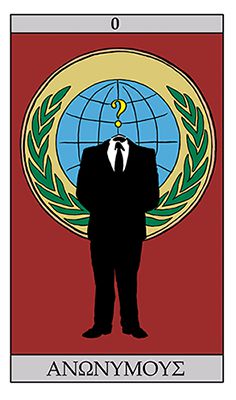
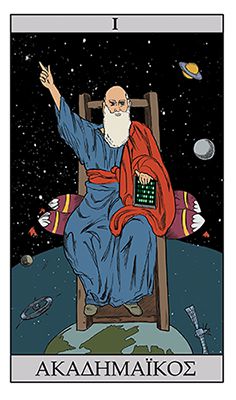
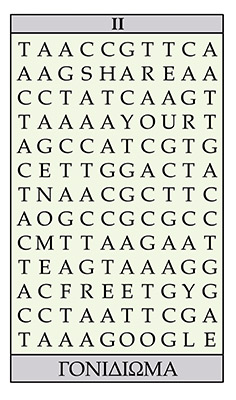
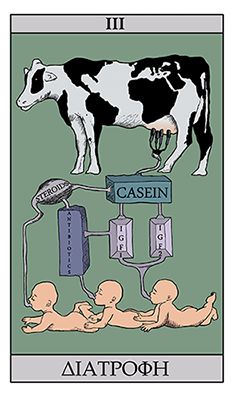
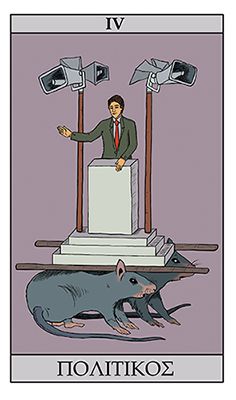
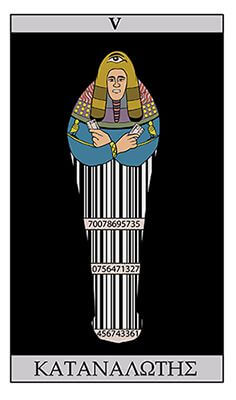
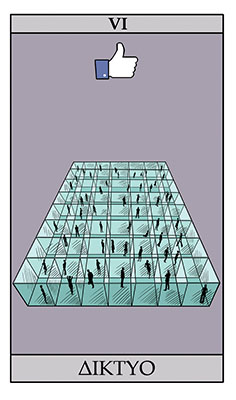
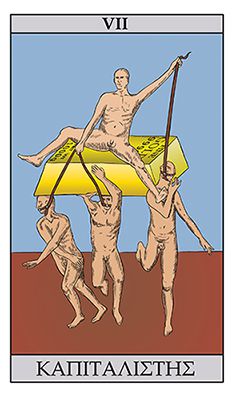
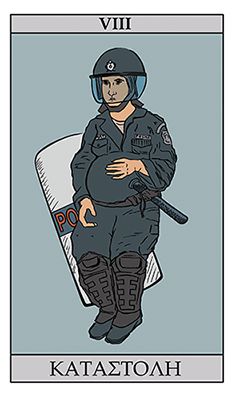
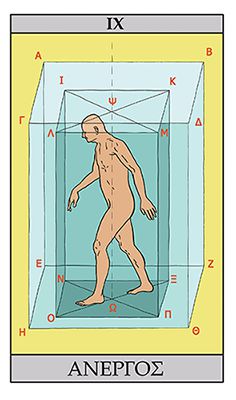
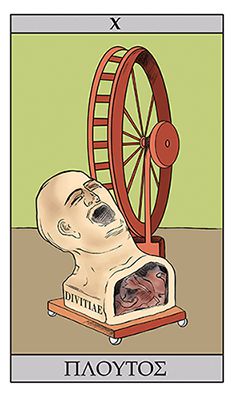
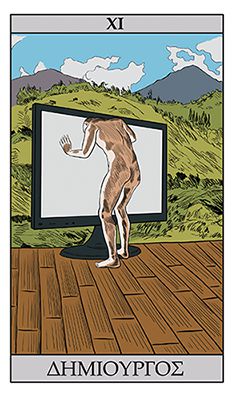
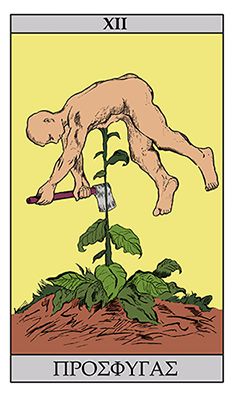
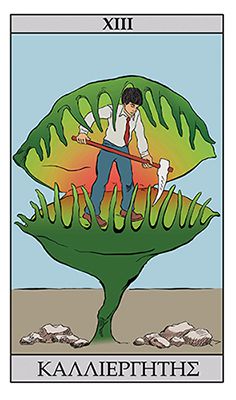
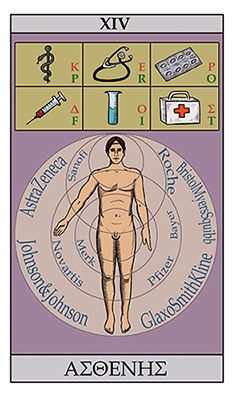
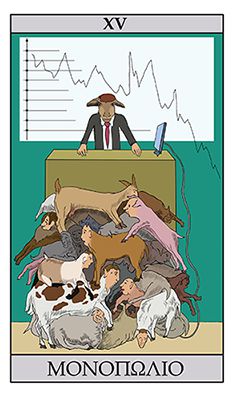
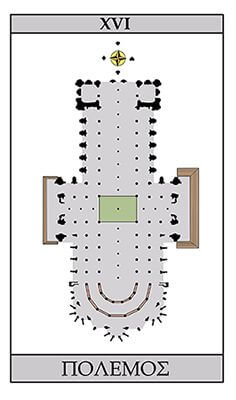
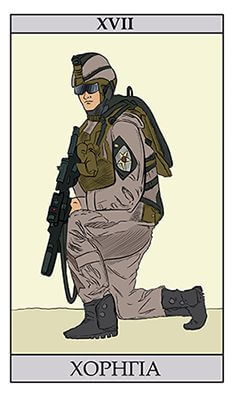
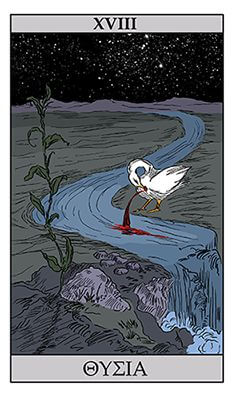
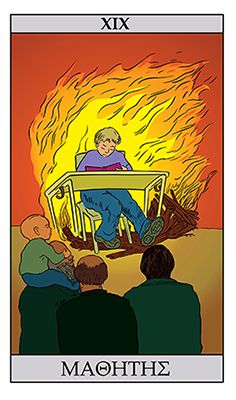
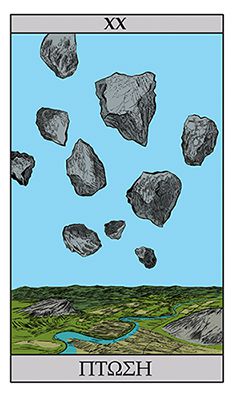
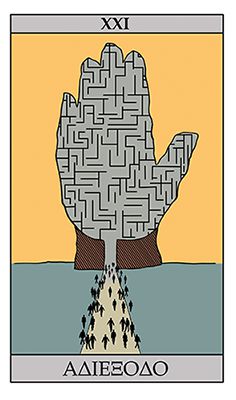
Ars Memorandi is a series of 22 cards, each of which constitutes a mnemonic image. They compose a story that most of us have forgotten.
At times of social, political and historical amnesia, the work’s cards act as a reminder for things that occurred or still occur around us. The structure in which they are placed is the functional space of each and every one of us, our place, our life.
The Ars Memorandi cards are cards of power, control and order, properties that only he who has a sound memory can have. The winner is the one who defines their space, has control over their perceptions, and remembers; otherwise the randomness of the images is what finally controls their destiny.
Nevertheless, the “random” appearance of the images is defined as such on behalf of he who is no longer able to construct or visit memory constructions so as to make the necessary connotation between the images. As Augustine says, whatever “has been set to consignment and retention” today is devoured by oblivion.
References
[1] "A huge historical weight presses on the memory chapter in Ad Herennium. It draws from Greek sources of mnemonic teaching, probably from Greek rhetorical treatises of which none survive," Frances A. Yates, The Art of Memory, trans. Aris Berlis, M.I.E.T. pub., Athens 2012, p. 23.
[2] "In his study of Guido Faba, also a member of the Bologna school around the same period, E. Kantorowicz has drawn attention to a spirit of mysticism permeating the school, a tendency to place rhetoric on a cosmic basis, to elevate it to a sphere of quasi-sainthood, to rival theology," op. cit. note 1, p. 93.
[3] Op. cit., note 1, p. 139.
[4] "According to Sturlese, Bruno assigns a function not only mnemonic but also inventive and interpretative. What is remarkable in Sturlese's work is how obvious the idea becomes that from a finite number of images we have the possibility of memorizing an infinite number of words, not only Latin but also Greek and Hebrew. Thus, we see that Bruno's wheel system is capable of creating a universal language using symbols," Ioannis Fikas, The Position of Giordano Bruno in the History of Philosophy and Ideas (PhD Thesis), National and Kapodistrian University of Athens, Athens 1998, p. 108.
[5] "It is characteristically reported that Thomas Murner (1475-1537) presented a logic system in a deck of playing cards! Baptist Pendleton (1651) used a deck for the practice... of teaching Grammar! And German philologists taught Latin in the 17th century with playing cards!" Kostas H. Hatziotis, newspaper TO VIMA.
[6] "Thus it is that a certain game, called the game of cards, has reached us in the present year, namely AD 1377." John of Rheinfelden, Basle, Switzerland. According to Michael Dummett, the first reference to cards in Europe is in Spain (1371) as "naip" in a Catalan document. Cards are described in detail in Switzerland by 1377. By 1380 they are reported in Florence, Basle, Regensburg, Brabant, Paris, and Barcelona. Seann McKay: General history of playing cards.
[7] Trionfi is the first name of the famous Tarot deck, which appeared in northern Italy in the mid-15th century. The initial name was carte da trionfi (cards of triumphs), but a few years later the name changed to avoid confusion with the playing cards we know today. They were named tarrocchi, a word of unknown etymology.